Ancient Civilizations, Mysterious Corpses, and Ghost Towns, Oh My!
Posted on 2026-02-27
Software development is an iterative process. Developing data intensive applications tends to be an extremely iterative process, as I (re-)discovered while building Nomadic Atlas. Nomadic Atlas, if you’re new to my blog, is a free directory of hidden gem travel destinations that I built over the course of 2025. The project is powered by a behemoth 12-stage data pipeline, the development of which turned out to be a Herculean game of whack-a-mole. Each iteration of my data pipeline dug up a new set of edge cases that I failed to consider during my development process and rendered the final product to be of questionable utility. Usually these edge cases were discovered through a manual audit of the travel destinations that the data pipeline found.
While it was clearly frustrating to realize that I had not yet landed on a final product during my iterations, the process of auditing the data did give me a chance to discover some interesting tourist destinations and stories about our planet. This article presents three of those destinations, but there are plenty more on Nomadic Atlas, which did finally end up in a usable state (shameless plug.)
Anyway, without further ado, here are some interesting things I learned about the world through my side project.
Chachapoyas Burial Sites
When most people, myself included, think of Peru, they probably think of the Inca civilization. Or maybe you think of ceviche first. But I bet you eventually get to the Incas. It may be surprising to learn that while the Inca people were hanging around Peru for a few hundred years, they only existed as the mighty empire that built Machu Picchu for about 100 years. This gave everyone else in Peru a whole hell of a lot of time to exist without being subjugated by them.
The Chachapoyas were one of these pre-Inca groups in Peru. Given the absolutely killer nickname “the Warriors of the Clouds,” the Chachapoyas lived in the northern region of Peru around the present day city that shares their name. They lived for an estimated 700 years until being subjugated by the Incas and eventually killed off by the Spanish and their diseases.
We don’t know too much specific information about the Chachapoyas. In fact, Wikipedia describes their language as “presumed” much like how I “presume” what they speak in Australia is English. Most of what we do know about the Chachapoyas is either from the archeological sites they left behind or from accounts of the Incas and the Spanish. From these sources, it certainly seems two of their favorite activities were fighting the Incas (even after being forcibly assimilated into the empire) and building burial sites in extremely remote and hard to reach places.
In terms of tourism, the burial sites make for a much more interesting discussion than killing the Incas. The Chachapoyas built their burial sites in two forms that we have discovered so far: sarcophagi and mausoleums.
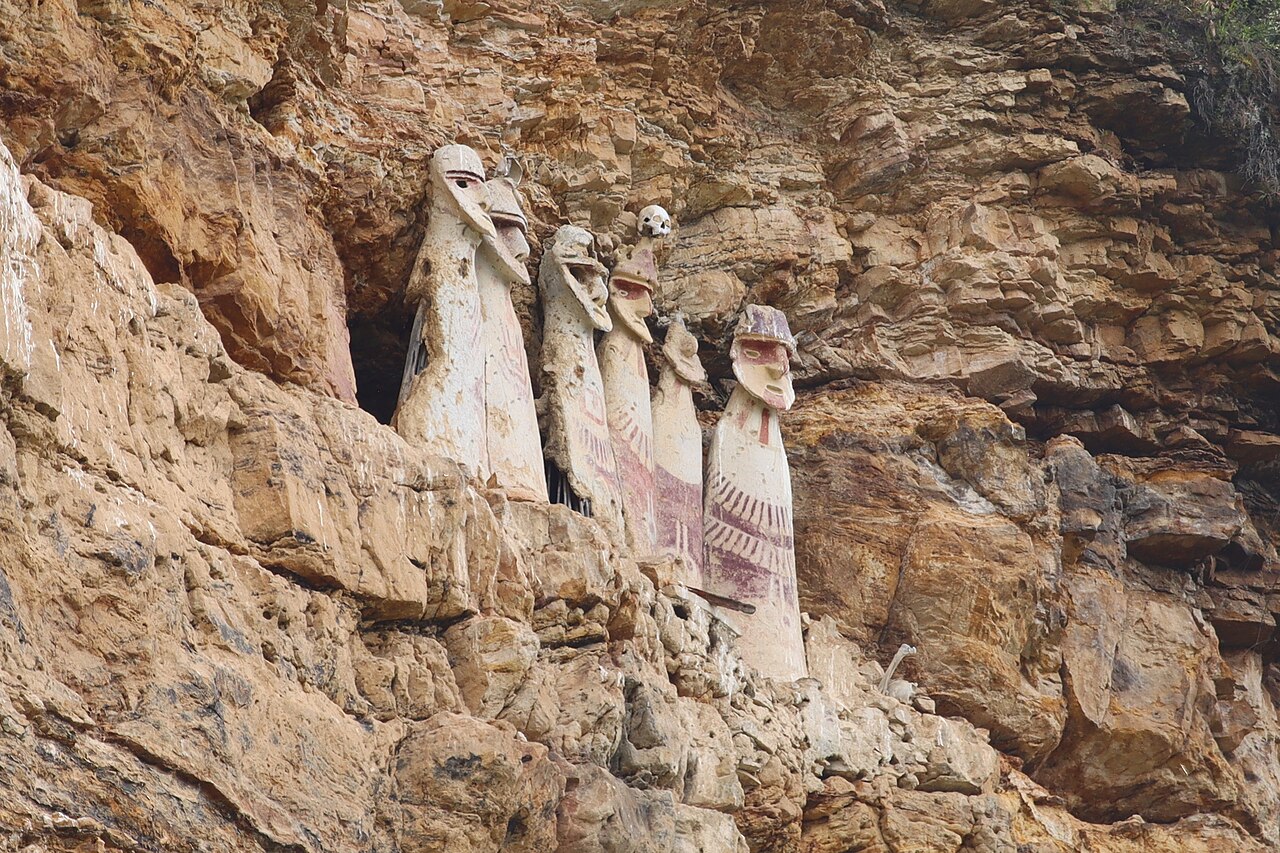
If you’re thinking Egyptian sarcophagi, you’re in for a hell of a surprise. A group of these sarcophagi, called the Sarcophagi of Karajía, are actually 8 foot (2.5 meters for the communists) tall stone statues that, in my opinion, resemble Easter Island heads more closely than they resemble Egyptian sarcophagi. Also, unlike Egyptian sarcophagi that were put into giant stone structures that were practically begging to be robbed, the Chachapoyas built their sarcophagi into a difficult to access cliffside, over 600 feet (200 meters) above the bottom of an also difficult to access ravine. They were pretty metal. Evidently, the heads on the Chachapoyas sarcophagi are solid, while the bodies are hollow and contained the mummified remains.
The second type of burial site is mausoleums. These were also built into the sides of mountains, such as the site at Revash. The mausoleums resemble small houses that are arranged into a tiny village. Unlike the sarcophagi, the mausoleums were raided by nature’s grave robbers: birds and rodents. Still, the mausoleums are in great shape because of how they were built into the cliffside.
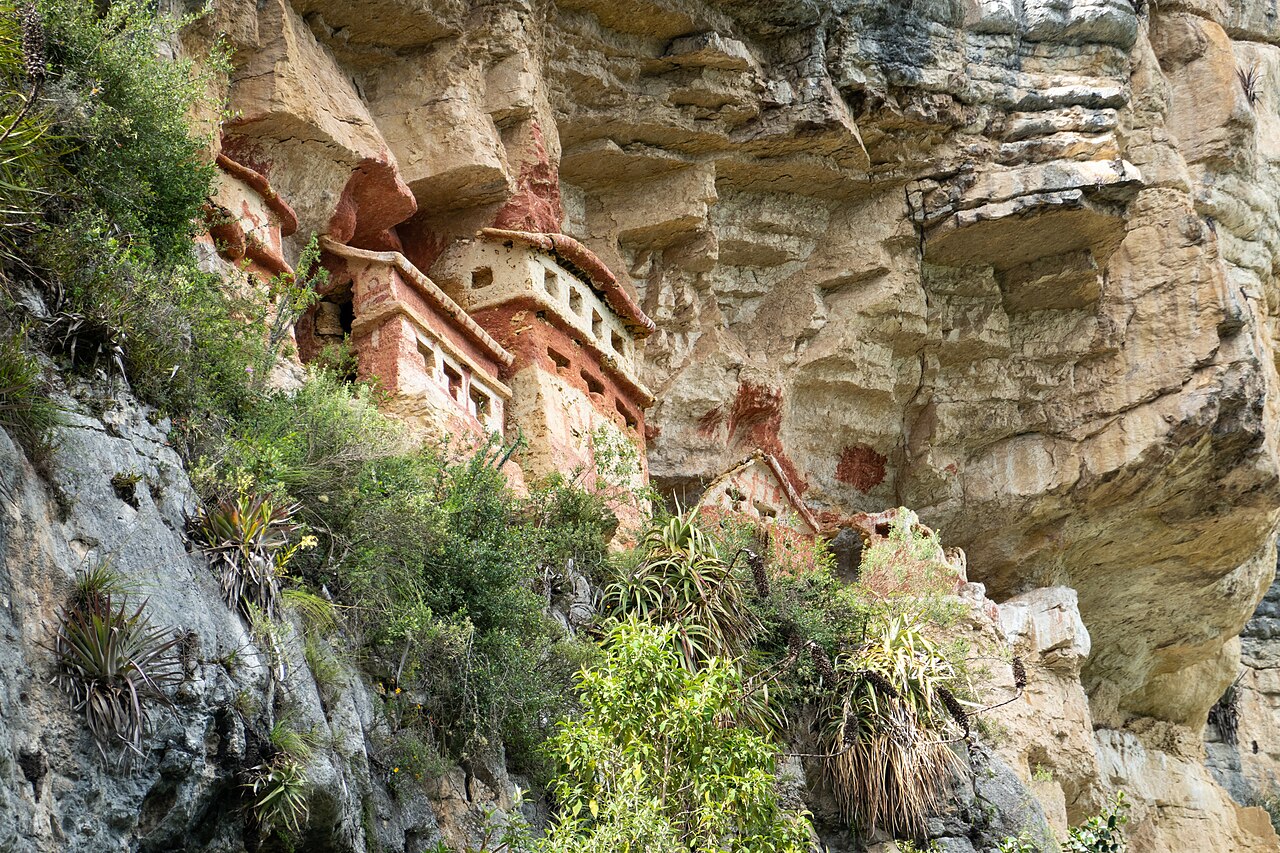
I found both of these sites while developing Nomadic Atlas (another shameless plug, but if you’re surprised at this point, I have some questions…), but I haven’t had the opportunity to go to either of them. From some additional Internet scouring, which is how I tend to use Nomadic Atlas, it seems like the sites themselves are both part of bigger treks. They are not near each other, but both accessible from the town of Chachapoyas. They’re certainly things I’d like to visit when I make it back to Peru and explore the north.
Lady in Red
Speaking of dead people, let’s talk about the Lady in Red.
This came up during some of my very early testing of Nomadic Atlas, when the database contained all sorts of interesting interpretations of what a tourist attraction could be. I saw the name “the Lady in Red” and was both terrified by the prospect of having found another bug and intrigued by the prospect of having actually found something interesting.
In 1969, near the town of Cruger, Mississippi, construction workers hit a peculiar metal object with a backhoe that was a few feet below the surface. The object that they had struck was a coffin, in particular, a type of metal coffin called the Fisk Metal Casket. Fisk Metal Caskets are the Ferrari of the casket world. They’re designed to be hermetically sealed and impenetrable, which was a huge selling point for wealthy families in the United States in the mid 19th century. I didn’t know this, but apparently, grave robbing was fairly significant problem in the United States around the time of the Civil War, primarily for the purposes of scientific research. The Fisk Metal Casket, along with preserving your loved one’s remains, was meant to deter grave robbers.
As a side note, the Wikipedia article for Fisk Metal Caskets describes them as being very expensive compared to regular people caskets. They cost about $3,500 adjusted for 2026 dollars, which the astute reader might realize is not far off from the price of a normal coffin today.
Complaint about inflation behind us, let’s do some more coffin talk. Because they did such a good job of preserving bodies, a common feature of Fisk Metal Caskets were a window so that you could continue to see your loved ones. Apparently, rich people were always weird. This, along with the fact that the backhoe had penetrated the impenetrable casket, made it easy for the construction workers to determine that the casket contained the body of a young woman that was suspended in an alcohol solution. Because of the alcohol solution, the body and the elegant red outfit that she was buried in were extremely well preserved, even being described as looking, “as good as the day she was buried.”
There is no information on who this woman is. In fact, stories that I read about her had extremely different interpretations of who she might be and how she got to this particular plot of land in Mississippi. Her outfit, and the Mercedes Casket she was buried in, suggest that the woman died sometime in the mid 19th century, potentially before the American Civil War.
As for what she was doing in Mississippi, the land was on a plantation, so some suggest that she may have had an affiliation with the plantation. The land has changed hands a number of times over an extremely long period of time, which definitely complicates tracking down her identity through the land records.
Fisk Metal Caskets were often used by wealthy people when they needed to transport a body over a long distance, so another interpretation is that she may have fallen off whatever transport was being used.
As for being a tourist attraction, while I’m sure some people are hoping that I’m going to say that the perfectly preserved body is on display in Cruger, Mississippi, there isn’t actually that much to see. She was reburied in a proper graveyard with just the name “Lady in Red” while her birth year shows her estimated birth year as 1835 and the year of her death is when she was re-interred in 1969. You can visit her grave though!
Craco
If your goal is to read at least one section of this blog post without reading about grave robbing, then I’ve got some great news for you!
Pompeii is probably what comes to mind when you think of abandoned Italian towns, but the category runs a little deeper than you might realize. A little over two and a half hours driving from Pompeii is the abandoned town of Craco.
As far as being an Italian ghost town goes, Craco has a few notable differences to Pompeii. There are, as far as anyone knows, no obvious corpses strewn about the town, especially none encased in hardened magma. This is because Craco was not forcibly abandoned by choice of a volcano, but rather semi-voluntarily due to an earthquake. Interestingly, unlike Pompeii, the population of Craco was not reduced to zero in Roman times, but rather in 1980!
Despite this, you won’t find a city littered with finance bros attempted leveraged buyouts, Jethro Tull albums, or other things I’ve been told were popular in the 80s. The history of the town dates back all the way to the 8th century BC, and the town center reflects this as well as classical era construction.
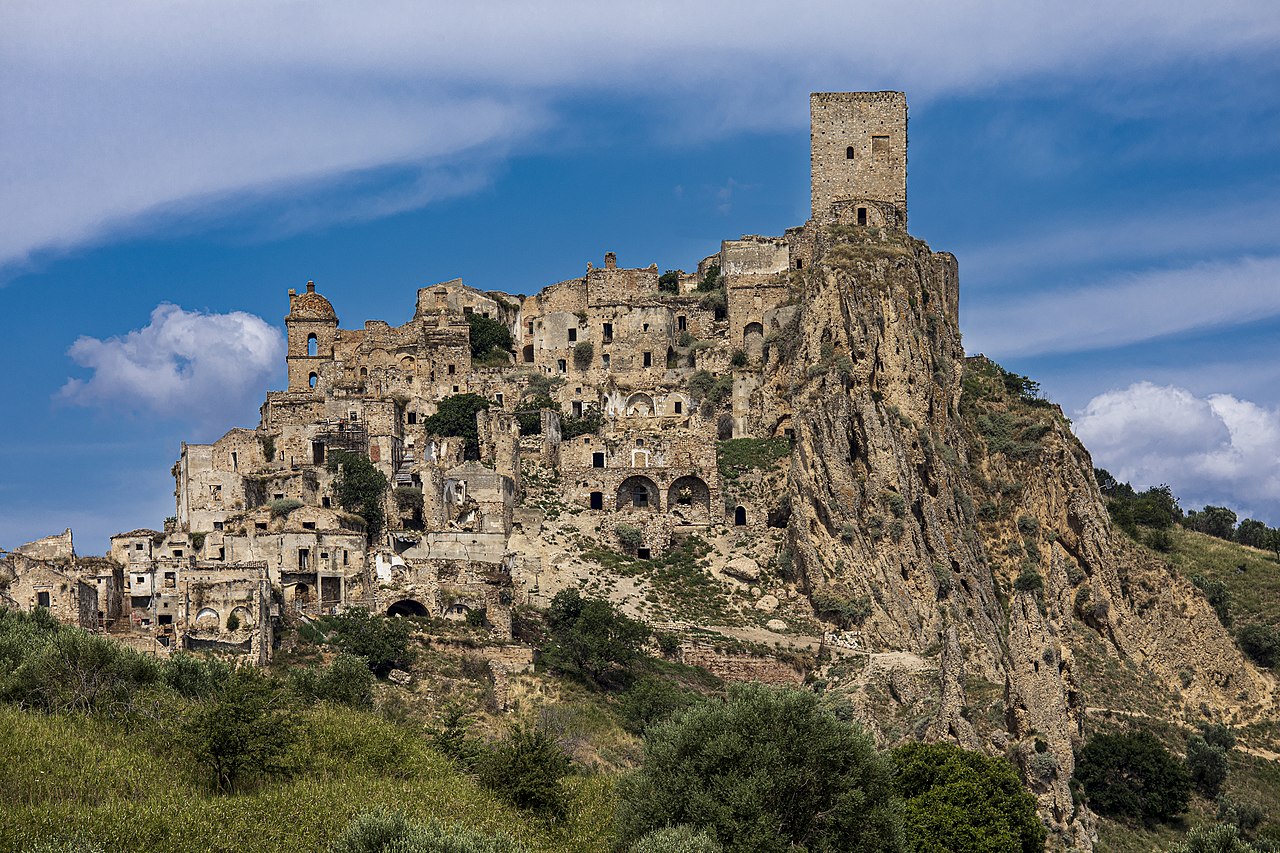
Today, the abandoned historic center of the town is often used as a film set for films such as Bruno Dumount’s France, which I assume is an aspirational film. You will also be pleased to learn that you can, in fact, visit it as a tourist. You do have to book a tour in advance, so you’re not allowed to roam freely about the ghost town. The tours are small, and Craco is pretty far off the beaten path, so it will still give you a ghost town like experience.
Learning More
As I alluded to at the beginning of the article, these weren’t the only interesting places that I found while building Nomadic Atlas. I’ve found completely quiet temples in the middle of bustling Thailand as well as quiet sprawling local parks in London that I visited to escape the intense summer crowds. You are free to search through the database yourself, as in it’s completely free. I’d appreciate you checking it out or reading my other blog posts. I am building side projects all the time and blog about the things I learn or discover.